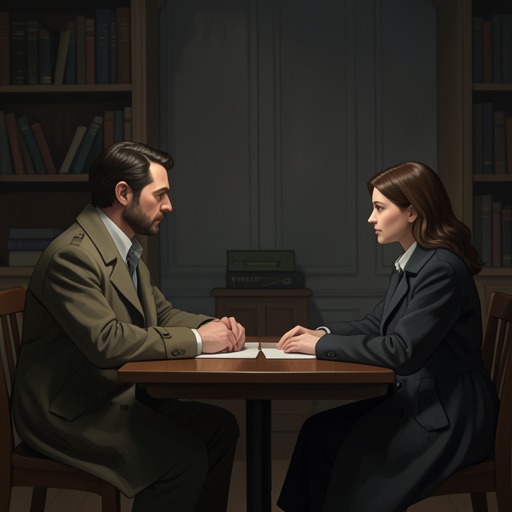
Holly Golightly
Breakfast at Tiffany'sHolly Golightly is a young woman who makes mobility both her public identity and her defense against belonging. First announced by a formal mailbox card that gives her name as Miss Holiday Golightly and adds only “Traveling,” she moves through the novel as an elusive presence, at once carefully styled and resistant to being claimed. Her story’s decisive tension lies between that independence and her eventual recognition that she and her unnamed cat did belong to one another.
Identity and Introduction
The narrator first encounters Holly indirectly: a week after moving into the brownstone, he notices the card for Apartment 2, printed in a style he associates with Cartier. Its wording—“Miss Holiday Golightly” and, below it, “Traveling”—becomes a phrase that nags at him like a tune. Before the narrator knows her history, the mailbox has already made her identity look like a performance of permanent departure: she has a name, an address, and yet declares herself elsewhere.
His first close view arrives on the stairs. Holly is nearly nineteen, though the narrator initially estimates her age somewhere between sixteen and thirty. Her hair combines tawny streaks with albino-blond and yellow strands; a slim black dress, sandals, pearl choker, and dark glasses set off a face the narrator sees as poised between childhood and womanhood. The impression is not simply of sophistication: he also notices her healthy, clean-cut appearance and the rough pink color in her cheeks. The uncertain age and mixed signals make her difficult to reduce to the polished image she presents.
A short, heavily built man follows Holly up the stairs, clutching her hip and nuzzling her neck. She pays little attention to his advances while searching her purse for her key. Once she opens her door, she thanks him cordially for seeing her home, then lets the door close on his protest. In this early encounter, she is neither merely passive nor openly confrontational: she controls the ending of the interaction by treating the man’s intimacy as a favor she can politely dismiss.
Names, Past, and Reinvention
Holly’s chosen name is not her original one. When the narrator recognizes her in Doc Golightly’s old family photograph, he sees a resemblance in the squinting, fat-cheeked child and realizes that the weary visitor must be Holly’s father. Doc corrects the assumption: she was Lulamae Barnes before she married him, and is now, in his understanding, his wife. He identifies himself as a horse doctor and farmer near Tulip, Texas, and says he has been searching for her for five years. A letter from Fred finally told him where she was, prompting him to travel by Greyhound to New York.
The difference between Doc’s account and Holly’s city identity is fundamental. He calls her Lulamae and speaks of bringing his wife home to their children; the narrator and the brownstone know her as Holly Golightly, a young woman who has made departure into a declaration. Her former name and marriage disclose a history that her fashionable appearance does not explain, while Doc’s search gives her flight a concrete human consequence: people who understand themselves as her family have not forgotten her.
Independence and the Meaning of Belonging
Holly’s most direct account of her independence comes while she holds the cat. She calls him a poor creature without a name, but says she has no right to name him until he belongs to somebody. She and the cat, she explains, have simply taken up together; they do not belong to each other, because he is independent and so is she. Naming, ownership, and attachment are joined in her mind: to give the cat a name would be to claim a relationship she is not yet willing to claim.
That refusal is not a simple rejection of home. Holly says she does not want to own anything until she knows she has found the place where she and her possessions belong together. She is unsure where that place is, but insists that she knows what it feels like. She uses Tiffany’s to describe the feeling, while explicitly distinguishing that refuge from a straightforward love of jewelry. Diamonds appeal to her, but she considers them unsuitable for younger women; she imagines wearing them later, with age and white hair. Her reference to Tiffany’s is therefore less a statement about luxury than a way of naming security and ease.
Her account of the mean reds sharpens the distinction between ordinary distress and the fear she faces at the end. The mean reds are not simply the blues; they are a more unsettling state, which she associates with feeling afraid without knowing what is frightening her. Tiffany’s offers an imagined place where that panic might give way to calm. Yet the cat scene shows that her theory of independence has limits: she speaks as though neither of them belongs to the other, even as the tenderness of holding and tickling him reveals an attachment her language tries to defer.
Arrest and Public Image
Holly’s private life is abruptly recast as a public scandal when newspapers report her arrest in a narcotics case. The headlines describe her in conflicting sensational terms: a playgirl, an actress, a glamour girl, and an alleged participant in a drug-smuggling ring connected to Sally Tomato. One paper’s photograph shows her entering police headquarters between two detectives, still in riding clothes after the horse incident. Her windbreaker, blue jeans, dark glasses, disordered hair, and dangling cigarette are presented as evidence of a gangland identity rather than as the details of the clothes she happened to be wearing.
The newspaper account identifies Holly as a twenty-year-old Hollywood starlet and café-society celebrity, and reports the district attorney’s allegation that she was an important figure in an international drug ring. The distance between that public image and the young woman previously seen on the stairs is part of the shock. The papers turn her into a fixed character—glamour girl or criminal—just as her own chosen name and traveling status have resisted a stable identity. The coverage records accusations, not an established account of her guilt, and its theatrical descriptions expose how swiftly public attention can replace a person with a headline.
Change, Departure, and Narrative Significance
By the time Holly leaves New York, her language about independence has begun to change. Looking past the narrator toward the boy offering her cat for sale, she shudders and grips the narrator’s arm. She says that she and the cat did belong to each other and that he was hers. The admission reverses her earlier insistence that neither owned the other. It does not make her suddenly secure: she still steps into the waiting limousine and asks the driver to go, leaving the cat behind while the narrator promises to find him.
Holly then names what frightens her as the possibility that the pattern could continue forever: not knowing what is hers until she has thrown it away. She dismisses the mean reds and the imagined protection of Tiffany’s as inadequate against this recognition. Her mouth is so dry that, she says, she could not spit even if her life depended on it. The image makes her fear bodily and immediate; this is no longer the nameless anxiety for which she once imagined a refuge, but the terror of understanding loss after acting on the assumption that nothing could truly be hers.
Her departure does not settle into a return or a conventional reconciliation. The narrator later reads that the fleeing playgirl has been traced to Rio, and, in the spring, receives a postcard signed with a lipstick kiss. Holly reports that Brazil was unpleasant and Buenos Aires better, says she is attached to a wealthy man who already has a wife and seven children, and admits she is looking for somewhere to live. She promises an address when she knows it herself, but none arrives. Even after acknowledging the cat as hers, she remains in motion, writing from one temporary situation without supplying a lasting home.
Holly’s characterization depends on this unresolved contradiction. She is capable of tenderness and of seeing the danger in her own habit of relinquishing what matters, yet recognition does not immediately overcome that habit. Her mailbox’s “Traveling” is more than a playful label: it anticipates a life in which reinvention offers freedom while making durable attachment difficult. The unnamed cat becomes the clearest measure of the cost. Holly leaves without him, and the narrator, rather than Holly, eventually keeps the promise to search. Her story thus makes belonging neither a possession secured by a name nor a refuge found simply by arriving somewhere; it is a relation that can be recognized only after it has been put at risk.